Software is now user-generated content
Many years ago, before I got into tech, I was bored at work and sketched out a thing I called the Content Value Spectrum.
It was a hand-drawn horizontal line with ‘low-value content’ plotted at one end, think spam emails, troll comments on social media, Taboola chumbox runoff, etc, and ‘higher-value’ content at the other: viral tweets, good blogs in Google Reader, paid newsletters, bestselling books, and so on.
The original drawing is long gone. However, a faithful reproduction is available here for your viewing pleasure 👇
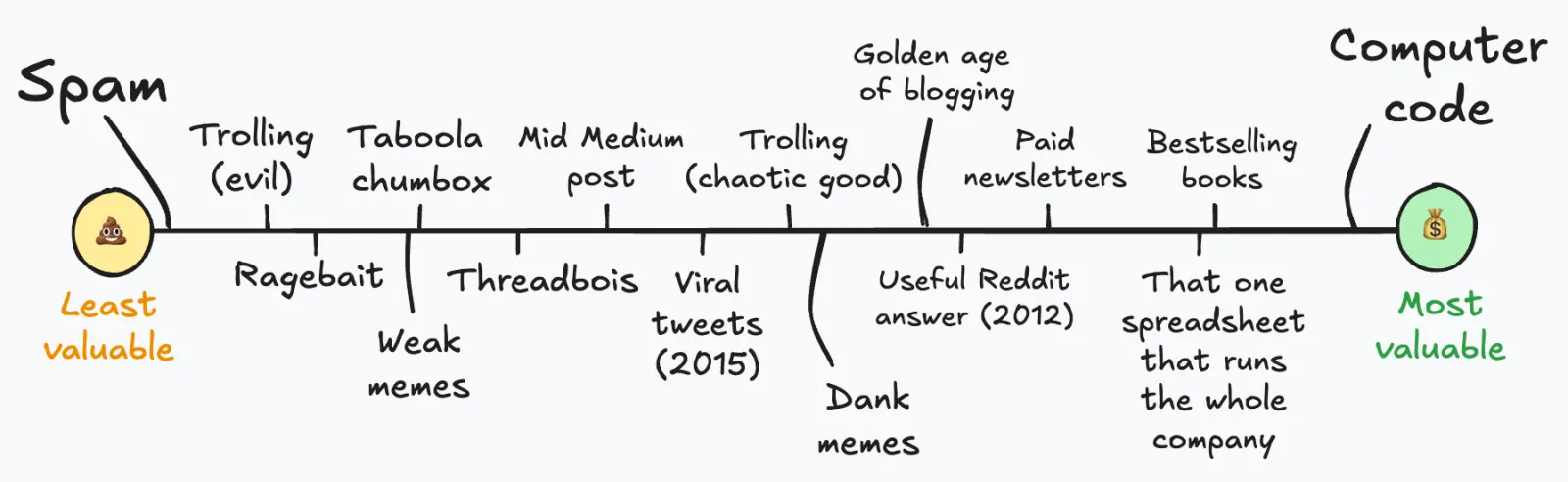
I could never figure out if it should be a linear line, a quadrant, matrix, map… whatever. It doesn’t matter. What matters is what I put at the furthest end of the Content Value Spectrum. The most economically-valuable content* my pre-COVID brain could comprehend: “computer code”.
Now that vibe coding and AI coding agents are here, I think back to that thought exercise a lot. Just how valuable is code now? Where would it fall on that imaginary line today?
One thing seems clear: computer code and software have tumbled down the value chain. They’re now slumming it with the user-generated content parts of the spectrum.
It started with a chart
In June, a chart showing the explosion of new app submissions to Apple’s App Store, driven by agentic AI, went viral on the tech part of X The Everything App.
Massive output uptick due to agentic AI. Complete flat adoption. pic.twitter.com/s6ubPsy0SL
— Jen Zhu (@jenzhuscott) June 5, 2026
So far, so old hat. AI agents make number go up, etc.
But the chart had another trend line that was very interesting indeed: the lighter blue line showed that NONE of these new apps were gaining any adoption among actual humans.
Several members of the Tech Twitter Commentariat piled on with the same (low effort) take: the reason for this dearth of users was obvious. It’s the distribution, stupid.
I think the challenge is that everyone can now build apps
— @levelsio (@levelsio) June 6, 2026
But
1) almost nobody has distribution (like an audience), or
2) the money to pay for distribution (ads or UGC), or
3) the creative genius to get distribution for free (classically called guerilla marketing) https://t.co/aqd40jQ4pq
Distribution is the new moat https://t.co/DLzw6aHiVZ
— Lenny Rachitsky (@lennysan) June 6, 2026
It’s not the distribution
Software software everywhere and not a user to drink is not a distribution problem. Not in the way Lenny and Levels framed it.
It’s more of a new category problem. A witness the unfurling of a new long-tail problem. A put your goggles on for the front row seat to the big bang of something new problem.
To go back to my spectrum, it’s a value of a previously very valuable thing suddenly going to a number much closer to zero problem.
To the extent that it’s a distribution problem, it’s that the rusted-on old ways of distributing software: app stores, Product Hunt posts, Twitter/X launch threads, oh my god you guys check this out influencer affiliates, etc, are no longer fit-for-purpose.
Software is now user-generated content. That means infinite software: a lot of it good, most of it meh, and some amount that will change the world, for better or worse.
And what’s really fun about this new category of content is that we get to see it before the next new platform comes along to harness it and commoditise it.
This is inevitable. Abundance is here, which means Aggregation Theory is here too. Entirely new discovery-focused platforms are coming. They’ll draw you to them to build, host, post and share new software / widgets / apps / mini-apps / interactive-somethings you vibe-coded on the fly.
So more than distribution, it’s discovery, stupid. And like the content types of yore, the creator economy is going to go absolutely hog wild on vibe coded software.
You could say things are about to get a whole lot... click-ier (ugh I’m so sorry).
Meet the new platform players
There are many contenders already making a first play at becoming this new discovery platform for UGC software:
- Meta acquired the team behind Gizmo and launched a social vibe-coding network called Pocket.
- Raycast released Glaze for building and publishing Mac apps.
- Google has both AI Studio and Sheets canvas for making mini-apps in spreadsheets (or something).
- On the indie startup side, Plethora Labs is employing a bit of good old-fashioned category design, trying to reposition this interactive content as “Bits”.
- On the more well-capitalized startup side there’s Wabi, a “personal software platform” (also a category designed phrase) from the founder of lockdown-era AI companion app Replika.
I could go on. There are, and will be, others. Lovable recently raised a monster new funding round and is boasting that a million projects are being made every week.
I’ve been a bit of a Lovable skeptic in the past, but the joke’s clearly on me (well done team). I guarantee those cracked Swedes are thinking about how they can become the next great aggregator. They now own lovable.com now. It’s coming.
Will they be able to get around Apple’s App Store rules? Will it matter? Who knows.
Evan Armstrong gets it. In “Who Gets Rich When Everyone Can Code”, here’s how he sees this new content category playing out:
For the app market, there are five ways the value will likely be distributed:
- Social mini-apps: Building a new age YouTube or Instagram for apps, with coding and social sharing baked into the platform.
- Studio system: App creators will have their own network of agencies and ad partners.
- General-purpose building: Tools will charge cheap subscriptions for code and try to monetize the services surrounding the apps.
- Vertical integration: Meta, Google, or XAI will embed apps native into their existing attention platforms, monetizing the same way they always have.
- Token monsters: Coding agents like Claude or Codex monetize on the volume of code generated.
It’s still not written if any of these new platforms will succeed in the UGC software space. Maybe they will. But I’m not super convinced there’s much reason to seek out vibe coded stuff made by other people just yet.
To put it in Girardian mimetic desire terms: why would I want to browse a mobile feed of vibe coded stuff made by others while I’m sitting on the toilet? Especially when the other content platforms — Twitter for text, Instagram for images, Reels/TikTok for video — have all nailed that job-to-be-done so well? Am I not entertained? (I am!)
Make it emotional
The “why” for seeking out a vibe coding platform as a consumer is probably two-fold: games and emotional engagement.
The games one is obvious. Vibe coding Flappy Bird back into existence is something everyone of a certain age and demographic has done already. So let’s focus on the second one.
Infinite user-generated software means, like all the other commoditised content mines out there, riches in niches, lowest-common-denominator crap, and a bunch of funny, sad, stirring, enraging, and just plain clever and creative stuff.
User-generated software should start moving you in ways traditional software hasn’t really done in the past (nor has it needed to). It should tickle your brain, hit you between the eyes, jab you in the solar plexus, or put a lump in your throat. It should contribute to the cultural zeitgeist.
Here again Evan Armstrong gets it. In “The Ghost Poet in The God Machine”, he wrote about vibe-coded software that moved him, quite literally, to tears.
For my sins, the first thing I ever vibe coded was purely for one thing and one thing only: shitposting.
To test out Lovable last year, I made a “Petty Rivalry Generator”, productising a tracker for my stupid goal of getting more LinkedIn followers than someone who shall remain nameless.
(Someone who, to this day, still has no idea about this one-sided, extremely low-stakes rivalry they are unwittingly a part of. How petty am I!!)
If you want to see said monstrosity, I’ve embedded it at the bottom of this article for posterity. It’s... something 💀
Who will make the main app maker?
Curiously, the most common emotion I feel when I see other people shill their own vibe coded software is mild irritation.
I think: “I could’ve prompted this myself and made it more useful and toned down the Tailwind slop. Also, how long are you actually going to maintain this for? Who are you to think this is good enough for others?”
This is definitely a me problem, but I suspect there are others like me (dozens!) who also feel this way.
I wonder if this crankiness is an inherent challenge of this new content category? Or, going back to the Girardian mimesis point, it’ll get solved by the future platform having viral mechanics? Maybe seeing vibe coded stuff go viral will make me respect it.
That’s possible. I certainly don’t think “I could’ve filmed that” for every trending TikTok video that comes my way. In fact, it’s the opposite. I think: “My remake of this would have been unwatchable and filled with millennial pauses.”
Anyway. Software is now user-generated content. We’ve got the creation part done thanks to the frontier AI labs, now let’s bring on the consumption part. May the best new platform win.
And as for what said platform-slash-future aggregator might look like, in an Uber for X elevator pitch kinda way, I’m thinking Pinterest + TikTok + Product Hunt + AI Twitter + GitHub + Hacker News + Glitch (RIP).
Most likely, though, it’ll resemble none of those things. It’ll be something we’ve never seen before, but looks so obvious and inevitable in hindsight.
Bonus Val vibe slop
As promised, here’s my completely normal Petty Rivalry Generator. Open it in its own tab if you want more room (why? Why would you want that?)
Footnotes
*I also realised that UX writing was probably pretty far up the Content Value Spectrum and was something I might be good at. This was one of the butterfly wing-flapping moments that started my journey into product content design—but that’s another story.